










Unsubscribe
View in your browser

FEBRUARY 2026

This ClimateFast newsletter shares information about the Climate Crisis that may interest our readers, but does not necessarily reflect the views of ClimateFast as an organization, nor those of its members. If you have an event or resource you would like to share, please send it to newsletter@climatefast.ca.

PLEASE NOTE: This newsletter may be truncated when you receive it; click on 'view entire message' at bottom to see the full document.

 
TORONTO CITY BUDGET 2026
 

We're coming to the end of the city's long budget process, with Mayor Chow releasing her version of the 2026 budget February 1 (and discussing it at a press conference February 2). The last step is a special meeting of City Council on February 10 to consider that document. You can watch that meeting online here.

Thank you to everyone who sent a letter to the Budget Committee, made an in-person or online deputation to same, or tuned into a town hall. Every time we speak up about what makes a liveable city (including transit, bike lanes, affordable housing, mental health supports, reducing greenhouse gas emissions, more nature, etc.), we remind our municipal representatives that there are a lot of us for whom this matters.

 
CLIMATEFAST IN ACTION
 

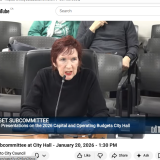
    CF @ North York City Hall Jan 20 | CF @ TO City Hall Jan 20


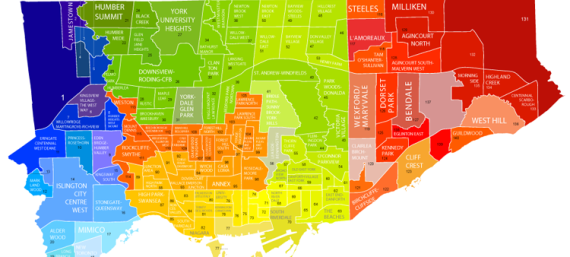
WARDS PROJECT UPDATE

We're sure you heard the news that our hard work throughout 2025 was well worth it, and TransformTO 2026-2030 was passed by Council on December 16.  While the current version of the plan does not include a commitment to a Buildings Emissions Performance Standard (BEPS),  the Council has instructed staff to bring forward a plan to address reducing building emissions in 2027.  This is essential in order to reach emissions reduction targets, as buildings are the largest source of emissions in Toronto.  (The 2027 date is after the next municipal election - Oct 2026 - so we need to be sure to elect a council that will follow through on this commitment.)  If we had not made the deputations that we did, this commitment would not have been made and the city would have omitted any plan for this largest source of emissions. 

The approach of the Wards Project to create positive and sustainable relationships with our councillors worked. Councillors have taken notice and are connecting the dots that with a strong climate action strategy we can build a strong, resilient and beautiful city for all. Councillors who have met with Wards Project teams either made motions to strengthen TransformTO; introduced our petition with 100s of signatures; or, stood in council chambers and asked thoughtful questions as a result of conversations with you. 

So, what’s next for the Wards Project?  We would like to invite you to help us answer that question! 

While TransformTO 2026-2030 has passed through Council, there is still much to do to ensure it is fully supported and implemented. Toronto is already way behind on its targets and we need a strong council to get us back on track. An election year brings challenges, but also opportunity.  We also realize that we need stronger provincial and federal support.  

There is a lot to think about, and many options we might take.  So, we thought it might be fun to get us all together in person for a combined celebration of the passing of TransformTO and an informal planning session for our next steps!

Whether you led a group or just thought about calling your councillor, you are invited to attend our gathering on Saturday, February 7, 10 am -12 noon at Friends House, 60 Lowther Street. Please RSVP to: wardsproject@climatefast.ca  by February 2. 


CLIMATE VOTING RECORDS WEBSITE

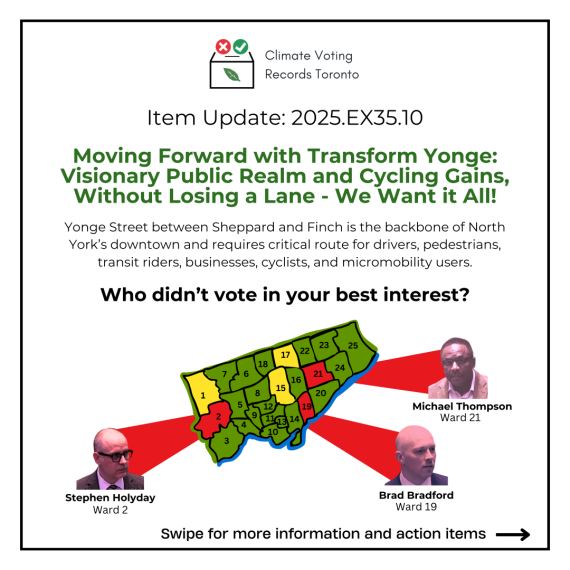
Yonge Street between Sheppard and Finch is the backbone of North York’s downtown and is a critical route for drivers, pedestrians, transit riders, businesses, cyclists, and micromobility users. This item directs staff to “explore the feasibility of extending the plan north to Steeles Avenue to align with the Yonge Street North Secondary Plan." This item helps make North York a more cycling- and pedestrian-friendly place. This item was proposed by Councillor Lily Cheng and seconded by Mayor Olivia Chow. Councillors who did not support the item include Brad Bradford, Stephen Holyday, and Michael Thompson.

Find the VR site at votingrecords.climatefast.ca  |     Follow us on Instagram @climatefastaction
 
CALLS TO ACTION
 

TELL THE FEDS WE NEED NET ZERO BY 2040

This e-petition by John Grogan, British Columbia, calls on Canadians to demand that the federal government:

1. Set a goal to cut greenhouse gas emissions in half by 2035 and reach near [net] zero by 2040;
2. Establish through legislation, a national carbon budget to plan Canada’s emissions; and
3. Report each year on whether Canada is meeting this carbon budget.
 CLICK HERE TO SIGN THIS CRUCIAL PETITION
 

BUILD CANADA'S EAST-WEST GRID WITH RENEWABLES

Canada’s electricity demand will double, or even triple, by 2050. We need a power grid that is fit for the future that provides clean, reliable and affordable electricity for Canadians.

We’re calling on the government to invest $20 billion over five years in new electricity transmission connections between provinces, supports for Indigenous-led projects, and training for workers.

A stronger and more connected grid offers hundreds of thousands of jobs, reduced pollution, real energy security and lower energy bills. We can do this all while upholding Indigenous and workers’ rights and benefitting communities from coast to coast to coast.

 CLICK HERE TO DEMAND REAL NATION-BUILDING!
 

LET'S WAKE UP FROM ONTARIO'S NUCLEAR NIGHTMARE

At midnight, October 31, 2025, the Ford government stuck  us with a 29% increase in electricity generation costs due to our dependence on high cost nuclear.

To offset this increase on your electricity bill, Premier Ford raised the taxpayer-financed Ontario Electricity Rebate from 13.1% to 23.5%.

Raising taxes to subsidize electricity prices doesn’t make sense (unless of course you own nuclear or gas companies e.g. OPG, GE Hitachi, Bruce Power, and Enbridge).

Tell Premier Ford to lower our electricity rates AND taxes by investing in low-cost wind and solar power, and cancelling the construction of new high-cost, U.S. nuclear reactors..

CLICK HERE TO  SEND A LETTER TO PREMIER FORD
 
COMING EVENTS
 
Fund Our City:
Toronto 2026 Budget Rally

When: February 10; 12-2 pm

Where: Outside City Hall (100 Queen St. W.)

Who: Social Planning Toronto and others

What else: More details (including lots of budget-related resources) and register here

Towards a Multi-Party Approach to Electoral Reform in Ontario

When: February 10; 7-8:30 pm

Where: online

Who: Ottawa chapter of Fair Vote Canada

What else: Members of NDP, Liberal and Green Party involved; register here

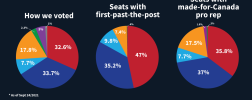
Watch this CBC newsclip from 10 years ago re proportional representation vs FPTP!

E-Bikes: Lots to Love. Let's Deal with the Problems

When: February 10; 7-8 pm

Where: 412 Bloor St W.

Who: Toronto Community Bikeways Coalition and Curbside Cycle Toronto

What else: Register here

Long-Term Waste Management: Reduction & Diversion Plan

When: February 11; 7-8:30 pm

Where: online

Who: City of Toronto

What else: Register here; also complete an online survey by March 8

The Changing Climate: A Canadian Perspective

When: Tuesdays Feb 17 - Apr 7;1-2:30 pm

Where: Eight-week online course

Who: Climate Action for Lifelong Learners (CALL)

What else: With Dr. Martin Bush; $25; register here

A Conversation with Steven Guilbeault

When: February 25; 7-8:30 pm

Where: online

Who: Climate Action for Lifelong Learners (CALL) and Seniors for Climate

What else: Register here

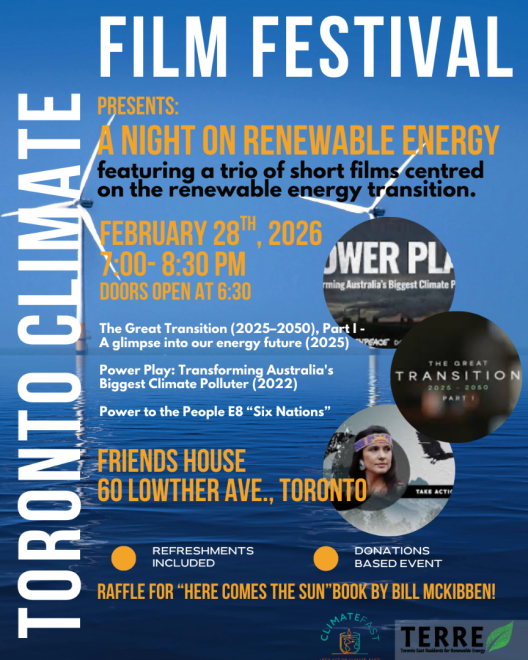
Register here: Toronto Climate Film Festival Presents: A Night on Renewable Energy. Tickets, Sat, Feb 28, 2026 at 6:30 PM | Eventbrite

 
RESOURCES & INFORMATION
 

Mitigating the Health Impacts of AI Data Centers. Harvard Business Review, Nov 5, 2025

The rapid growth of AI isn’t just a power challenge—it’s also impacting public health with an annual cost of up to $20 billion in the U.S. by 2028. As public health begins to take center stage in global discussions, it’s time to demonstrate leadership in responsible AI by proactively integrating health impacts into the design and deployment of AI—an approach called “health-informed AI.”

People's Consultation on AI

On October 31, 2025, more than 160 academics, experts, advocates, civil society and human rights organizations across Canada submitted a joint letter they had signed, protesting a severely deficient consultation process to develop a “national AI strategy” led by Evan Solomon, the Minister of Artificial Intelligence and Digital Innovation.

The signatories announced that, instead of legitimizing Minister Solomon’s fatally flawed process, they would instead participate in a parallel and independent process - the People’s Consultation on AI. This is that consultation.

 
FINAL THOUGHTS
 

Excerpted from Talking Climate by Katherine Hayhoe - When AI Hurts the Climate - and When it Helps (January 22, 2026)

"AI, and especially generative AI such as Large Language Models (LLMs) and other tools that can generate videos and images, brings up strong views and increasingly urgent concerns ...

It’s important to note that AI is not the same thing as data centres. About a third of current data centre capacity is used for AI: the rest supports the many other ways we also use data every day, from accessing our household bills online to watching our favourite show...

Today, as this Nature Climate Action perspective explains in detail, there are numerous ways that AI can help accelerate the low-carbon transition, if used wisely and well. This includes optimizing power grids, catalyzing behavioural change, and improving climate and policy modeling ...Obviously, though, it would be much better for all our data and AI needs to be powered by renewable energy: and a brand new report by the Union of Concerned Scientists shows how smart policy could put that goal within reach...

Although AI only accounts for about a third of current data centre usage, it’s much less efficient: and rather than increasing its efficiency, companies are just building more. Not only is this driving a massive increase in electricity demand, but the energy the data centres are relying on is mostly fossil fuels. In the U.S., for example, data centres’ energy is nearly 50% more carbon-intensive than the grid. And of course these servers, infrastructure, and cooling systems require large amounts of fresh water as well...

The real environmental issue with all of this is not that we use energy, data, and even AI. They aren’t inherently bad in and of themselves. What determines their impact is how they’re created, how they’re used, and what powers them. And right now, there’s no question that much new AI technology is using energy inefficiently and operating with no transparency or oversight, and with no regard to its harmful side effects."


ClimateFast is run solely by volunteers  - if you would like to make a donation,

please e-transfer any amount to

finance@climatefast.ca

We are grateful for your support!

 Facebook  Web  Instagram  Youtube